The NextScalp bot finds a setup and hands you the evidence: the event, the levels, the order flow, how fresh it still is. What it cannot do is watch what happens after you tap the alert - whether you sized up after two losses, chased a move that had already run, or gave back most of the profit before you finally exited. That half of trading never touches the bot. So I built the other half as its own product: NextScalp Journal (opens in a new tab), a self-hosted trading journal that rebuilds your actual Binance or Bybit fills into real trades and shows you where you really lose.
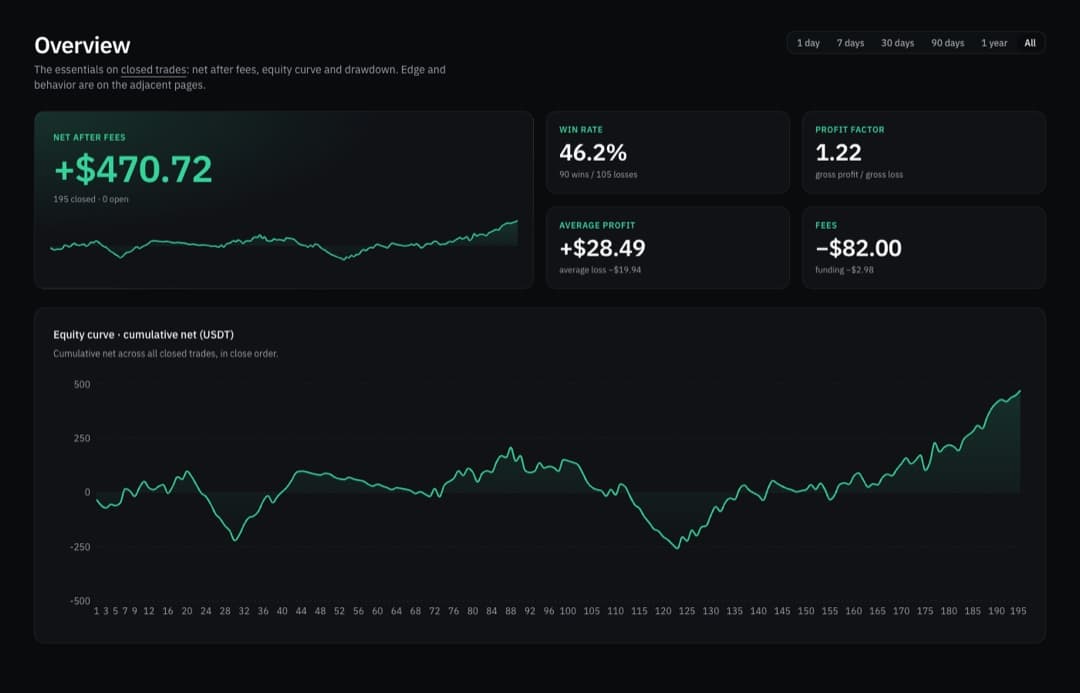
From radar to mirror
The bot and the journal solve opposite problems. The bot is a radar pointed at the market: it watches every USDⓈ-M perpetual at once and throws away 97% of what it sees, so the 3% that reaches you is worth acting on. The journal is a mirror pointed at you: it takes the trades you already took and refuses to flatter any of them.
Keeping them apart is deliberate. A radar that also grades your discipline would be doing two jobs badly, and a journal that also fired signals would be a signal bot with extra steps. The bot answers "is this setup worth my attention." The journal answers "given how I actually behaved, where does my money really go." Different questions, different products, one brand thread.
Most futures traders do not lose to the market. They lose to the same handful of habits on repeat, and they cannot see it because the broker only shows a flat list of fills. Binance tells you what filled and when. It does not tell you that your win rate collapses after two losses in a row, that one symbol is carrying your entire month, or that you keep trading past the point where you swore you would stop for the day.
Reconstructing real round-trips from raw fills
Before any of the analysis is possible, the raw data has to become trades. Binance hands you fills - scale-ins, partial exits, add-backs - not positions. NextScalp Journal collapses each position cycle, entry to flat, into a single round-trip with realized P&L, net after fees and funding, and hold time computed per trade.
type RoundTrip = {
  symbol: string;
  side: "long" | "short";
  netAfterFees: number; // fees AND funding subtracted - the honest number
  mfe: number; // max favorable excursion - the profit you had
  mae: number; // max adverse excursion - the heat you took
};
Then each trade is enriched with the context the broker never stores: the coin's 24h volume at entry, how far price had already moved in your direction, and the maximum favorable and adverse excursion. Those two excursion numbers are what make the behavioral read possible - without knowing the profit you had, you cannot measure the profit you gave back. Scalpers who work one idea as several entries can also merge them into a single logical trade, so one idea counts once everywhere instead of splintering the stats. Everything renders on the server, straight from your Postgres. Your keys and your trades never reach a browser, and there is no vendor backend to reach them anyway.
The behavioral read the bot can't give you
This is the part the radar structurally cannot do, and it is the reason the journal exists. The Behavior page is the product's signature - what the data knows about your habits that you would rather not admit.
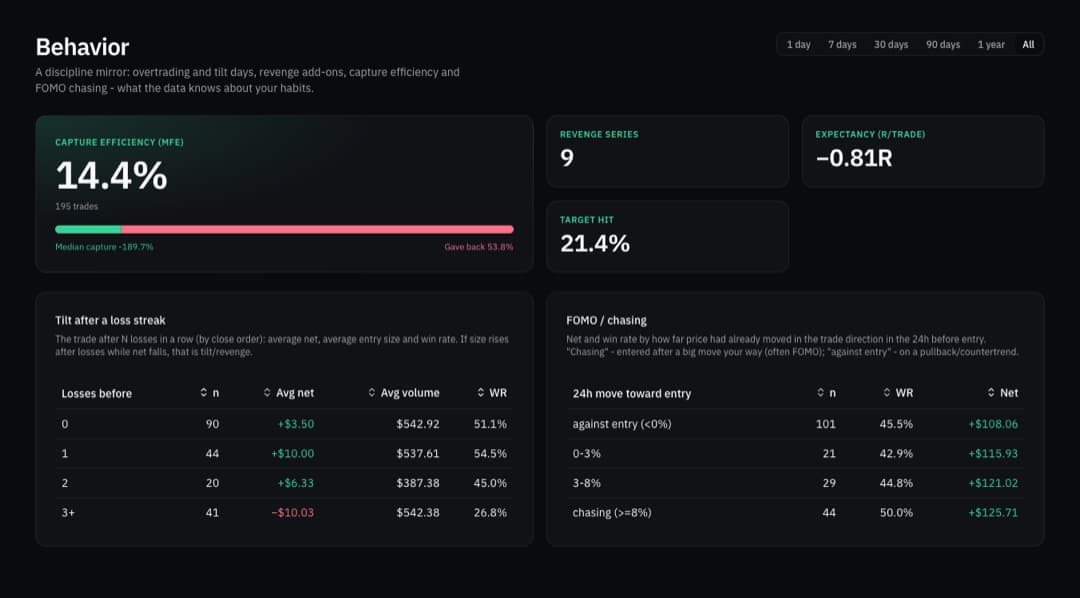
It measures tilt as a number: the trade taken after N consecutive losses, its average size and its win rate. If size climbs while net falls after losses, that is revenge trading, not a hunch. It counts revenge add-ons - runs of re-entries into the same symbol where position size grew after a loss. It measures capture efficiency against MFE, so you see how much of the favorable move you actually kept, and a "gave it back" share for the times you were green and exited flat or red. And it reads FOMO by how far price had already moved your way before you entered.
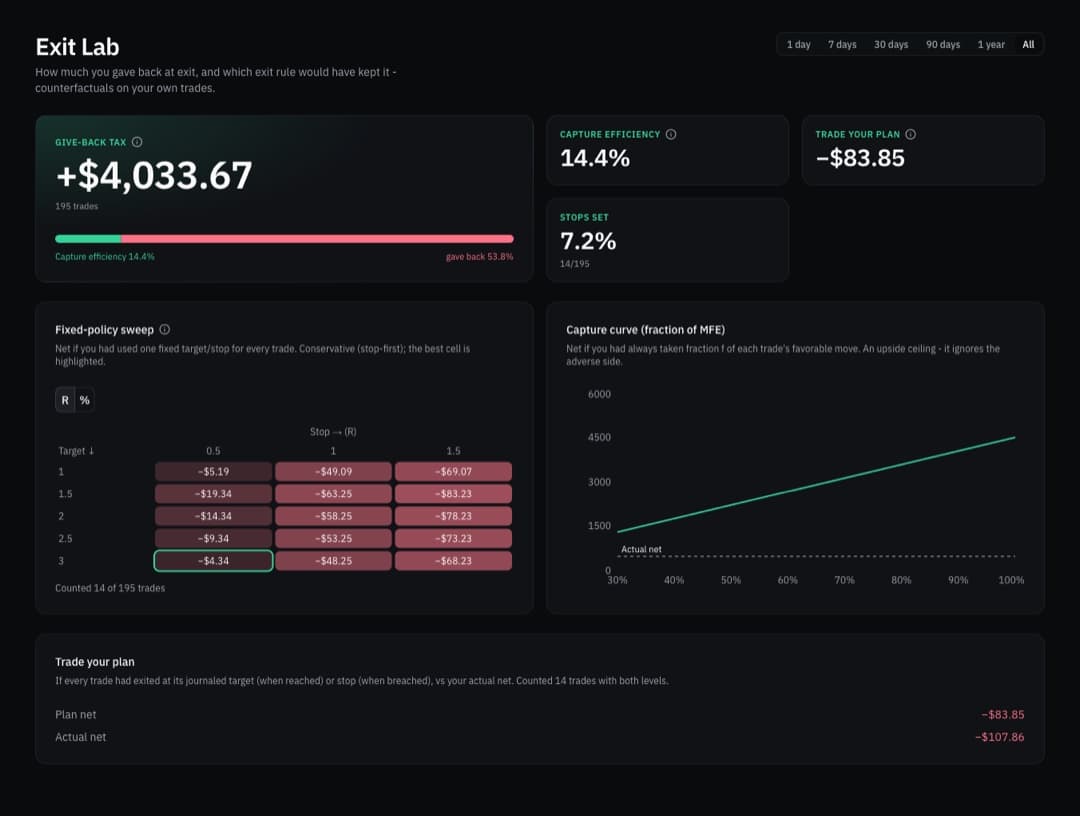
Exit Lab takes the give-back further: it replays your own exits and asks what a fixed target and stop, or the plan you wrote in the journal, would have made instead - all on your real candles, nothing on a model's imagination. Where a target and a stop were both reachable and the order is unknown, it counts the pessimistic case. Honest by construction, including when honesty costs you a nicer number.
The Discipline page closes the loop: you set your own limits - max trades per day, a daily loss stop, max consecutive losses, position and risk caps - and it scores every closed trade against them. The framing is deliberate and outcome-blind: a profitable rule-break is variance, not vindication. Discipline is measured by how often you broke the rule, never by whether you got away with it.
Self-hosted, same as the bot
The differentiator is architectural, not a marketing line. Your trades, P&L, behavioral patterns and journal notes live in your Postgres. The sync needs only read-only Binance keys - it can never place, modify or withdraw. Secrets stay server-side, and login is a Telegram allow-list of the numeric ids you choose, so there is no separate identity provider and no auth tables to leak.
There is exactly one outbound path, and it is opt-in. The per-trade AI audit and the weekly AI Coach run through your own Anthropic key, only when you click, sending only that trade's numbers and your note. Leave the key unset and the feature simply stays off; every other analytic needs no third party at all. It is the same rule I hold across the whole NEXT line: AI shows up only where it changes the answer, metered and on your terms.
You do not have to take my word for the analytics. There is a read-only demo (opens in a new tab) loaded with a realistic few months of trades - the behavioral mirror, the discipline breaks, Exit Lab, all populated - no account or API keys required. When you want it running against your own fills, the journal (opens in a new tab) is $59 once: the full source to self-host, twelve months of updates, and every version delivered in that window stays yours to run. The bot is the radar; the journal is the mirror. If you want to argue about any of this, LinkedIn (opens in a new tab) is the fastest route.