I have been building NextWine for about two years now, and the problem it solves has not changed once in that time. Most people don't have a wine problem. They have a choice problem. A wall of unfamiliar labels, a grape they can't pronounce, a price range with no obvious logic, and one nagging question: will I actually like this, and does it go with what I'm eating? The expert who could answer that in ten seconds is never standing in the shop aisle or sitting next to your laptop at 8pm on a Friday. So I built NextWine around a single idea: there should never be only one way to ask. Describe it, quiz it, or browse it. Every path ends in the same place - a short, explained shortlist instead of a thousand labels to scroll.
The choice problem, not a knowledge problem
The fix for "I don't know what to drink" is not a wine course. It's guidance. People default to the same three bottles forever, overpay for the label they recognise, or freeze and buy nothing - and none of that is a knowledge gap you should have to close alone. The right bottle almost always exists. What's missing is someone to narrow thousands of options down to the few that fit you, this meal, this occasion, and then explain the pick so you can trust it instead of guessing. That narrowing is the entire job, and it is the one thing a wall of labels can never do for you.
Three ways in, one answer
NextWine has three on-ramps so there is always one that fits how much you already know. Tell it what you want in plain language and the AI sommelier returns a matching set. Answer a few quiz questions if you don't have the vocabulary yet, and watch the library narrow with every answer. Or browse the full catalog with rich filters when you know roughly what you're after. Three doors, same destination: a small, explained shortlist. Nobody is forced down a path that assumes knowledge they don't have, and nobody who knows exactly what they want is made to sit through a quiz.
Browse the whole library
The library is the heart of the product: 400+ wines across 230+ grape varieties and 15+ countries, every one described by hand. You can refine it across many dimensions at once - category (still, sparkling, fortified), colour, country of origin, sweetness, strength by ABV band, serving temperature, age, price band, and food pairing across dozens of dishes from pizza to beef to cheese. Sort by popularity, price, newest or rating. Search by name when you already have a grape in mind. Switch between an image-led grid and a detail-dense list, or hit "Surprise me" for a one-tap random pick. Every filter lives in the URL, so any view you build is a link you can share.
Every wine, fully described
A wine page is built to answer "should I buy this?" at a glance, then reward a deeper read. There's a pronunciation guide for the tricky names, simple 1-to-5 scales for fruit, body and tannins so the character is readable without tasting-note expertise, and the grapes, region and classification each link onward to "more like this." The food section checkmarks the dishes it pairs with, adds an expert note, and carries an honest "best on its own" flag for the bottles that don't want food at all. There are fun facts, an "also known as" list so a regional label never trips you up, similar wines, related articles, a one-tap add to wishlist, a jump straight into an AI recommendation seeded from that wine, and a QR code to share the page anywhere.
Take the quiz when you don't have the words
For anyone who doesn't have the vocabulary yet, the taste quiz is the no-jargon way in. You pick a quiz from a themed gallery, answer one simple multiple-choice question at a time with a live progress bar and optional hints, and watch every answer filter the wine pool toward the bottles that fit you. It teaches preference by doing - no need to tell a Syrah from a Sangiovese to walk away with wines you'll actually enjoy. It's also honest: when too few wines match your answers, it tells you so rather than padding the result. You finish with a tidy shortlist plus a recap of the answers that produced it, saved to your profile and shareable by QR.
The AI sommelier that explains itself
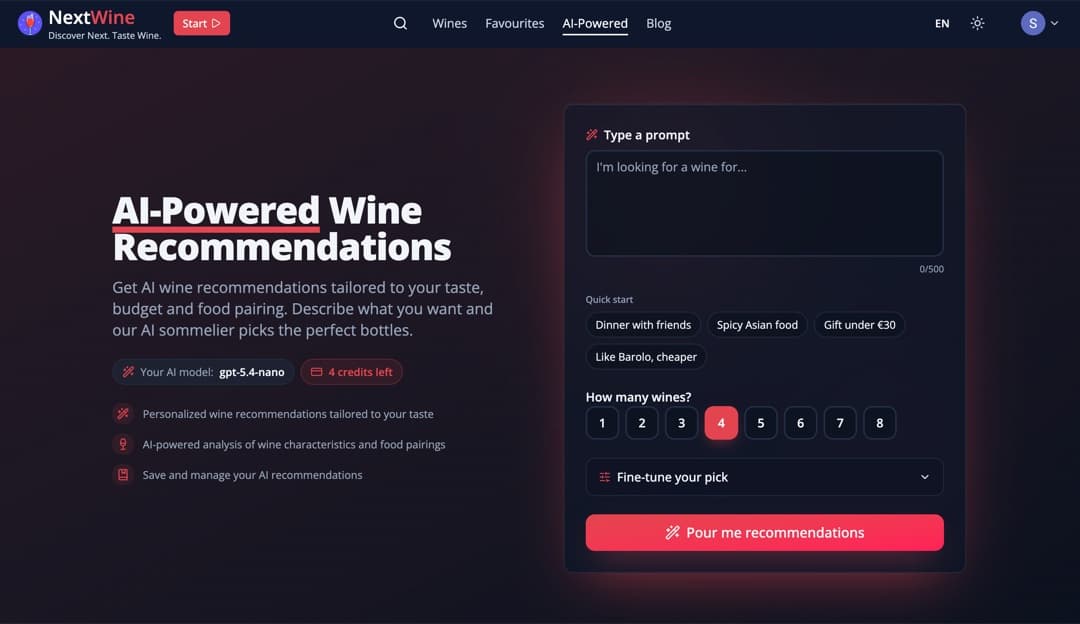
The AI sommelier is the fastest path from "I don't know" to "I'll have that." You describe the occasion - "a crisp white under $30 for spicy Thai food" - choose how many wines you want from one to eight, optionally narrow by origin and colour, and it returns a curated set with the reason each bottle fits, in your language. Two things make it worth trusting. First, it reasons only over the curated catalog, so it recommends real wines I can stand behind instead of free-associating from the open web. Second, it shows its work: every pick comes with its why, so it reads like a recommendation, not a slot-machine pull. It is summoned on your request and never runs in the background, every generation is saved to your profile and shareable, and the button tells you which model your tier unlocks before you spend a credit.
Your cellar: save, revisit, share
Signing in with one tap turns NextWine from a catalog into your wine app. The profile is a tabbed dashboard: every quiz shortlist you've made, every AI session tagged with the model that produced it, your wishlist of saved bottles, and the articles you bookmarked to read later. Everything is private to your account and preserved across sessions, and any recommendation is shareable by link or QR whenever you want a second opinion. The wishlist is language-aware too, so the bottle you saved is the exact bottle that comes back.
Learn as you drink
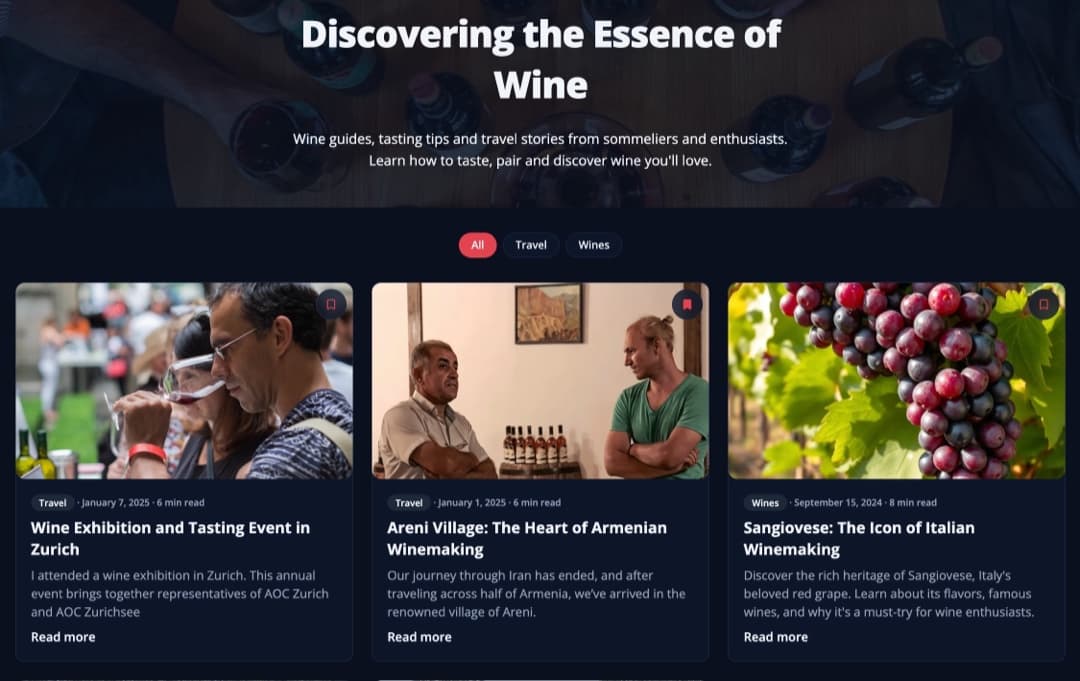
NextWine is also a place to get better at wine, not just buy it. The blog carries wine guides, tasting tips and travel stories from sommeliers and enthusiasts, browsable by category, each with an author bio, reading time, related links and rich imagery, and each one bookmarkable to your profile. It's the part of the product I'm pushing hardest on right now, because the same curated library that powers good recommendations also makes for honest, useful reading.
Pay only for what you use
There is no subscription and nothing expires on a billing clock. Browsing the library, taking quizzes, opening collections and reading the blog are always free. The AI sommelier runs on credits: every new account gets a few welcome credits to try it immediately with no payment, and one credit is one recommendation. Top up when you like through secure checkout, and a higher pack also unlocks a stronger model - your account keeps the best tier you've ever bought. Credits are reserved per generation and refunded automatically if one ever fails, so you only pay for a result you actually receive.
Curated, not scraped, always current
The AI is only ever as trustworthy as what it reasons over. Every wine, its taste profile, its food pairings, and every quiz and collection is maintained by hand in the content system rather than scraped into a dump. That is what makes the filters return real matches and the sommelier's "why" worth reading. Collections and locales hide themselves when they have nothing real to show, so you never hit a dead page, and when I publish a change the live site reflects it almost immediately - no stale catalog, no redeploy wait.
What's next
A first major release is in the works: a far wider range of wines and hundreds of professional articles in the blog, so there's more for you to choose from and more to learn from while the AI reasons over an even richer, hand-curated library. Two years in, the thesis still holds - the catalog tells you what exists, and NextWine tells you what's right for you, right now, and shows its work. If you want to see where it's headed, the best thing you can do is open it and ask it something.